The Film
Watch the Film
You can watch the film on Apple TV+ or have free access to the film for education and conservation purposes in East Africa. Please select an option below.
Available in English, Kiswahili & Maa
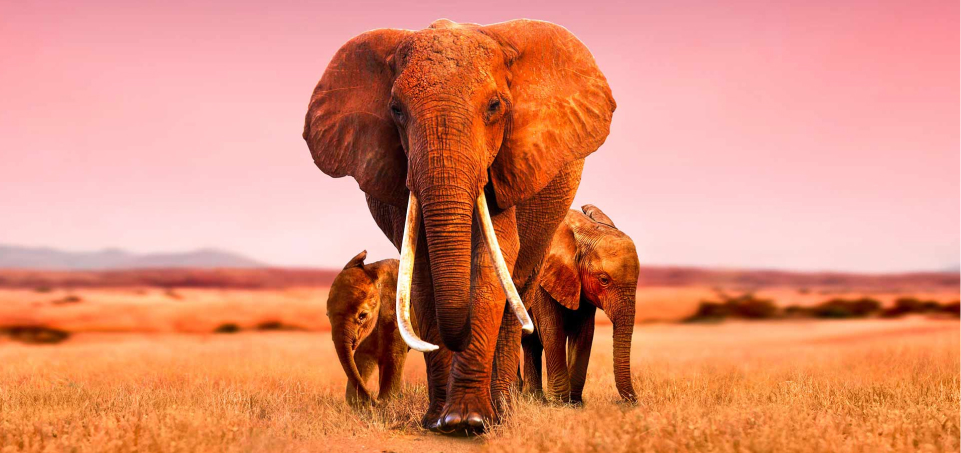
Athena is a mother who will do everything in her power to protect her herd when they are forced to leave their waterhole and embark on an epic journey across the African savannah in a tale of love, loss and coming home. Narrated by Chiwetel Ejiofor.
From the Directors
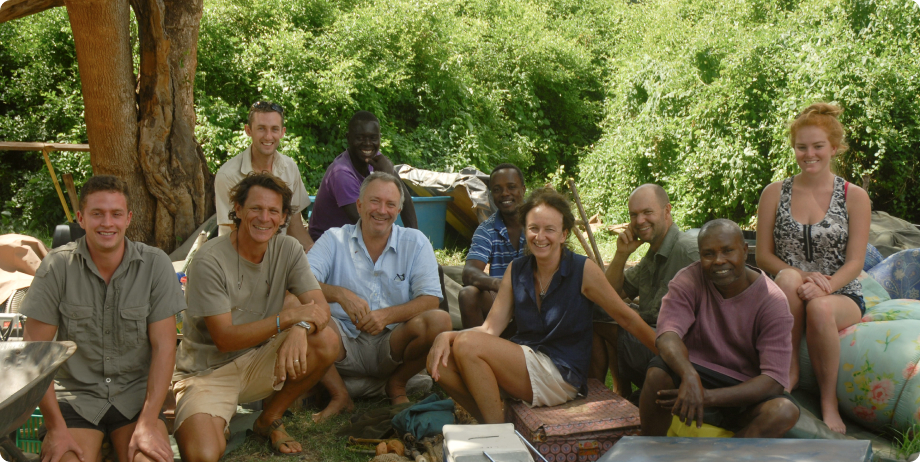
The Elephant Queen film is the result of 4 years filming in the greater Tsavo ecosystem, and 3 years in postproduction by a diverse, talented and committed team. We’ve always worked with a small team – several of us including Etienne Oliff and Norbert Rottcher have worked together for 25 years in Africa, making wildlife films for international distribution.
From the Directors of The Elephant Queen
The Elephant Queen film is the result of 4 years filming in the greater Tsavo ecosystem, and 3 years in postproduction by a diverse, talented and committed team. We’ve always worked with a small team – several of us including Etienne Oliff and Norbert Rottcher have worked together for 25 years in Africa, making wildlife films for international distribution.
Elephants had always been tangential part to our lives in the bush, but never characters in any of our films. Over the years we had stored up memories of scenes, experiences and interactions we’d seen, particularly of smaller animals with elephants – but we’d never thought of telling a story about them until we got caught up in a devastating drought in East Africa in 2009. Seeing how the elephants reacted, as families, in the face of such adversity made us realise just how like humans they are – the planning, decision making, leadership, empathy, grieving and sentience that they showed were astonishing.
But elephants don’t live in isolation – we had unique experience of the relationships they had with much smaller animals. We were excited about what the combination of an elephant family story, together with the drama of the daily struggles of the creatures that lived at elephant toenail height, could bring to the big screen. The cast of the elephants’ tiny neighbours promised to give us scenes of intimacy and humour compared to the elephants and their adventures. After three decades of living in the bush, we finally felt ready to make a film about elephants.
Our primary aim was to make a story-led film that would take an audience into the mind of an elephant matriarch and, by extension, deep into the elephants’ world. We wanted to show the decisions she had to make and what it took in terms of leadership, for her family to survive and flourish.
We didn’t want to make a traditional information-driven documentary, but tell an emotional story, based on what we saw over the four year filming period, backed up by 25 years of wildlife observation and experience. We wanted audiences to fall in love with elephants – for the simple reason that we need to love before we care, and only if we care are we moved to act.
It is a critical time for elephants and they need our care and support more now than ever. When it came to story-telling style – our aim was for a film that would combine elements of the Lion King with Shrek and March of the Penguins. Our objective was a film that would appeal to everyone – a combination of observational live action, combined with the type of humour and visuals that are more commonly associated with animation. If we had a narrative mantra, it would be ‘show, not tell’ – to give the audience the satisfaction of having their own experience.
Chiwetel Ejiofor was the perfect voice for the film with a soft, story-telling delivery – at times empathetic, at other times moving the story along. We didn’t want a voice that sat ‘out front’ or led the film, but a voice that bedded-in and was soft and lilting. We looked for a voice that would not trample on its subject, but coax it along – at times standing back to let the elephants and others speak for themselves, at others to be leaning in and warmly engaging, and we found this in Chiwetel’s voice.
The writing was an integral part of the process from the start of filming. At times we knew the lines we wanted to use before filming and they determined what we filmed, the type of shot and sometimes its duration. Possibly the biggest decision we had to make was on naming some of our characters (not something we have done before).
In part, this happened because we tended to give them names so as to distinguish one from another when discussing them. When it came to the script, we considered whether it was too anthropomorphic, but we felt that elephants share so many of our human emotions and feelings that not to name them (even scientists now do so) or show them as animals with emotions, would have been to do them a huge disservice.
As for Stephen, well the name just stuck and we couldn’t let it go – we tried a more Swahili name but feedback from a Kenyan test screening was hugely in favour of keeping Stephen.
From the outset we knew that natural sound would be an important part of the story-telling. The recording of these sounds was led by sound recordist and consultant naturalist, Norbert Rottcher and camera assistant Pete Cayless who, during the four years we spent in the field dedicated hundreds of hours to recording all the sounds we might need; from the squeak of a baby elephant to a Tsavo thunderstorm.
After an early demonstration of Dolby Atmos® at Wounded Buffalo Sound Studio we knew that the system would deliver the immersive soundscape we planned for the big screen. It gave us the ability to have up to 128 distinct tracks and pan the sounds across the cinema in a way that we hadn’t been able to achieve before. So much of elephant communication is by infrasound – that if you are close to them you feel, but it also has a auditory component in our hearing range that Tim Owens, the film’s sound supervisor brought to life in a way we wouldn’t have thought possible – the result is immersive.
We knew from composer Alex Heffes’ previous scores for The Last King of Scotland, Queen of Katwe and The First Grader that he was highly attuned to African sensibilities and subjects and that he had the ability to produce both epic melodies and work with the smaller more intimate scenes that are so much a part of the film. What we didn’t know was how much he cared about elephants, so it was the perfect fit. His music is at times powerful and dramatic, at others haunting, evocative and restrained but it has a coherence and apparent simplicity that complements the film in a way we could only have dreamt of at the outset. It can be difficult to read animal feelings and intentions, and we wanted to avoid predictable music for animals and sometimes play them ‘against type’. Alex’s score perfectly demonstrates what can emerge when the composer spends enough time immersed in the subject and reads it right.
For visual style, the most important word was intimacy – we wanted proximity so the audience would feel they were there – whether at the home waterhole or travelling with Athena’s family. During the ‘pre-journey’ phase of the film the camera is more static to suggest the concept and tranquillity of ‘home’ as a place where it feels good to be still and to dwell.
On the ‘journey’ we try to keep the camera on the move; sometimes accompanying the family, at other moments conjuring the feeling of travelling with the dust-storms or the rolling desperation associated with the drought.
Trying to achieve proximity sometimes meant flying up amongst thunder clouds in torrential rain in our light planes, with one person operating the strut-mounted camera with one hand and controlling the plane with the other, while another person filmed out of an open cargo door.
At other times it meant spending months in a cramped steel filming box below ground to film the action at dung-beetle eye level, or weeks waist-deep in waterholes waiting for metamorphosing bullfrogs.
Wherever we could, we shot the action from the viewpoint of the two worlds – either that of the elephants or the tiny creatures that live at elephant toenail height. Before the project started we had tested shooting RAW and were early adopters of the RED® camera system. We knew the film would take years to shoot and wanted to future-proof the material by shooting in 5/6K – the highest resolution available at the time, which was perfect for 4K display. Cinematographer, Mark Deeble was particularly keen to shoot RAW because of the artistic latitude it would provide in post-production, rather than having the ‘look’ baked in when filming.
So much of shooting wildlife under natural conditions is about ‘getting the shot’ and building the sequence and he felt this was where the emphasis should be, rather than be concerned with the ‘look’ in the field. After weeks of testing we shot the film using a variety of vintage lenses which had a smoother character that matched the timeless story we were telling, and were less clinical than their modern digital equivalents.
In editing, the same principle applied. We wanted to make an audience feel they were there, as if they’d experienced at first hand what we’d filmed. It meant letting shots play out as long as the action warranted it. It involved trying to avoid fast cuts that might help a difficult junction in a sequence, or add a pace that wasn’t naturally there, but would ultimately be less satisfying. Some shots, like the dung-beetle fight scene run for almost a minute without an edit. Over such a long period filming, it was essential that editing should begin in the field so that we could start to achieve the story-telling style we wanted, and make sure that sequences were fully covered.
Director, Victoria Stone, with the support of Laura Smith, Sarah Bright & Kerry Roberts, edited for the entire time we were in the field and then Victoria worked alongside editor David Dickie when back in the UK.
Editing and logging in tents had its challenges: scorpions and venomous centipedes liked to live in the dark recesses of the edit equipment cases; ants built their nests in computers; thunderstorms flooded the edit tent and rodents bit through electric cables and caused power outages on a regular basis. Keeping the generator topped up, meant a walk out into the bush in the dark with a can of petrol, where an encounter with elephants was a probability and a lion or leopard a distinct possibility.
We wanted a setting for the film that was different to anything that had gone before and would be completely fresh – Tsavo offered it. We knew Tsavo would be both a challenge and a risk, but one we decided to take. Tsavo’s elephants are not as tame and habituated as those in Amboseli or Samburu and consequently less photographed and less well known, but Tsavo is home to most of the world’s last remaining giant tuskers. They are iconic elephants of which only about 12 remain. They have enormous tusks – so large that they almost reach the ground, and it was these elephants that we wanted to celebrate. We wanted characters that took us back to a timeless elephant Eden – in part for narrative reasons, but also to show what we still have, and what is so threatened.
The problem was that they had been heavily poached and consequently were wary and secretive – some of the largest bulls only emerged from deep cover at night to feed, and some matriarchs were so defensive that they would charge from hundreds of meters away. It took almost two years to find our star matriarch and then months to win her trust, and be able to get close enough to film her family. We could never have imagined that one of our ‘stars’, the world’s largest tusker, Satao, would be killed by poachers over the period we filmed.
Tsavo offered us the cast of smaller animals we wanted to film alongside the elephants – animals that were absent from Amboseli and other elephant strongholds like Samburu. We knew that filming them would be a challenge. Bullfrogs mate for only a few minutes, normally at night, and only when the rains have been very heavy – which might be years apart. Finding them meant wading through pans inhabited by crocodiles and driving thousands of kilometres through the bush, stopping at every flooded pan and listening for their calls. We saw them mating, and managed to film it, only once in four years.
Finding their youngsters was slightly easier, for the tadpoles formed shoals that were visible from the air if we flew low and slow. We knew that the inclusion of the smaller animals would give a sense of scale and bring a unique dimension to the project, but it was essential that they had to add to the narrative by interacting with the elephants in some way, and it was achieving those sequences that took time.
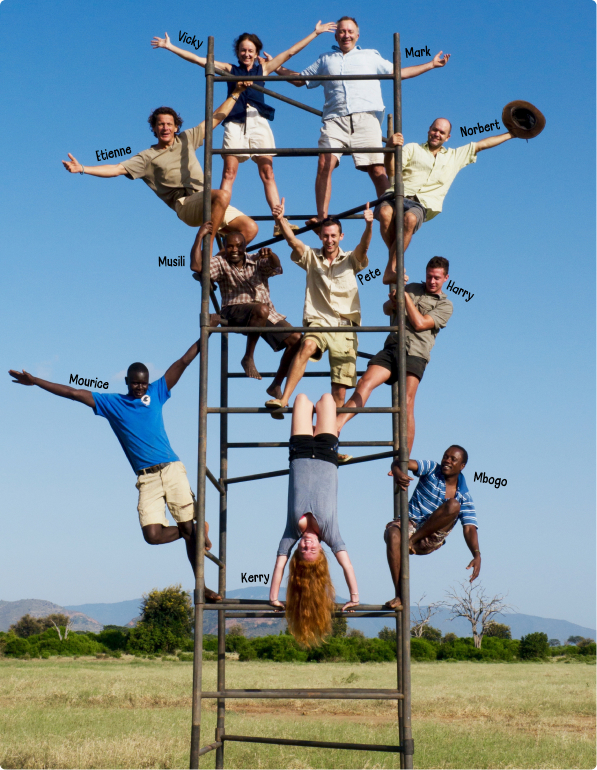
To achieve the movie took a dedicated field team – it always does, except this time the team needed to be in the bush for four years! Led by Etienne Oliff, the team grew and thrived through the intensity of close-living under canvas and the challenges that 4 years of filmmaking brought.
Musili Sakayo & Mourice Oyier with their small team, oversaw the camp kitchen and the upkeep of a small fleet of 4×4 filming vehicles and bush-planes. Over the course of filming we had a series of enthusiastic assistants and interns – notably Harry Williams, Jacca Deeble, Elsa Kent and Edward Dance. It was a happy crew and with assistant director Etienne’s talent at team building, a special camaraderie developed from which life-long friendships have evolved.
Thank you to everyone for inspiring the world to fall in love with elephants !

The Film is Just the Start
From the outset, the team wanted the film to make a real difference for elephants in Kenya – to help conserve elephants and support and foster environmental education. Through their commitment and determination, that hope became reality when, with the support of Bestseller Foundation, they were given the opportunity to design and develop a dedicated Elephant Queen Outreach and Education Project (O&E) which aimed to use the film to inspire an appreciation for wildlife, conservation and the environment. This website www.elephant.co.ke serves as the home for a toolbox of Elephant Queen conservation education resources which were created in collaboration with the Kenyan Institute of Curriculum Development (KICD), the Youth Theatre of Kenya, Kivukoni School and StoryMoja.
The Elephant Queen Outreach Program
From the outset, the film team wanted the film to make a real difference for elephants in Kenya – to help conserve elephants and support and foster environmental education.
Through their commitment and determination, that hope became reality when, with the support of Bestseller Foundation, they were given the opportunity to design and develop a dedicated Elephant Queen Outreach and Education Project (O&E) which aimed to use the film to inspire an appreciation for wildlife, conservation and the environment.
This website www.elephant.co.ke serves as the home for a toolbox of Elephant Queen conservation education resources which were created in collaboration with the Kenyan Institute of Curriculum Development (KICD), the Youth Theatre of Kenya, Kivukoni School and StoryMoja.
The mission is to take the film across Kenya, with a focus on schools and communities around national parks and conservancies which are most affected by human-elephant conflict. (HEC)
In partnership with Save the Elephants the film team have recruited a dynamic Kenyan mobile cinema team. Over 8 months from November 2021, in a 4×4 lorry with a giant cinema screen, they will travel across Kenya to show the film to over 150 schools and 60 communities and engage them in conservation education related conversations. All in collaboration with our partners from a huge range of conservation and civic organizations across the country.
The objective is simple – to use The Elephant Queen film to inspire people to fall in love with elephants and encourage an appreciation of Kenya’s unique wildlife and wilderness. Everyone involved hopes the impact of the film and the Outreach program endures and helps foster human-elephant coexistence in the country in which it was created.
Reviews & Press
- New York Times — Ken Jaworowski (Critics Choice)
- Vogue — Kerry McDermott
- LA Times — Michael Ordoña
- Elements of Madness — Douglas Davidson
- Fast Company — Adele Peters
- Hollywood Life — Marissa Charles
- Common Sense Media — Sandie Angulo Chen
- The Utah Review — Les Roka
- Apple Insider — William Gallagher
- Alliance Of Women Film Journalists — Alliance Of Women Film Journalists
Film Credits
- Told by
Chiwetel Ejiofor - Directed by
Mark Deeble & Victoria Stone - Assistant Director
Etienne Oliff - Written By
Mark Deeble - Produced by
Victoria Stone - Produced by
Lucinda Englehart
Film Credits
- Told by
Chiwetel Ejiofor - Directed by
Mark Deeble & Victoria Stone - Assistant Director
Etienne Oliff - Written By
Mark Deeble - Produced by
Victoria Stone - Produced by
Lucinda Englehart - Cinematography
Mark Deeble - Music by
Alex Heffes - Edited by
David Dickie - Co-edited by
Victoria Stone - Filmed in Kenya Tsavo East National Park & The Greater Amboseli Tsavo Ecosystem
- Executive Producers
Alan Root, Sara & Nick Williams - Co-executive Producers
Anders Holch Povlsen & Anne Storm Holch Povlsen, Sam Pattullo, Tim Owens - Associate Producer
Myles Connolly - Field Sound Recordists
Norbert Rottcher, Peter Cayless - Contributing Field Naturalist
Norbert Rottcher - Camera Assistant
Peter Cayless - Field Assistant
Harry Williams - Production Assistant
Laura Smith - Field Production Assistant
Kerry Roberts - Field Edit Assistant
Sarah Bright - Additional Photography
Etienne Oliff, Peter Cayless - Stills Photographer
Mia Collis - Field Crew Musili Sakayo, Maurice Oyier, Mbogho Kidelela, Jackson Chepkwony, Michael Ogutu, Roony Onyango
- Base Support Joshua Ochieng, Josphat Gona, Samuel Mtengo, David Omondi, Silas Kenga, Mtawali Chumbi, Shani Mohamed and Justus Ngowa
- Visual Post Production Onsight
- Colourist
Andy Lee - Online Editor
Maggie Maciejczek - VFX artist
Tudor Colac - Post Producer
Jeff Halsey - Head of Operations
Rik Tester - Development Producer
Laura Smith - Head of Development
Tony Maher - Post Production Supervision
Flat Dog Productions Ltd - Narration recorded at Warner Bros. De Lane Lea
- Voice Over Recording
Nick Roberts - Visual Effects
Panton Creative Ltd
Peerless Ltd - Audio Post Production
Wounded Buffalo Sound Studio - Sound Supervisor and Editor
Tim Owens - Sound Editor
Kate Hopkins - Foley Editor
Hannah Gregory - Re-recording Mixer
Ben Peace - Foley Artists
Paul Ackerman, Ben Jones - Audio Post Production Manager
Diana Smith - Supervising Orchestrator
John Aston Thomas - Orchestrators
Tommy Laurence, Geoff Lawson, Jessica Dannheiser, Rebecca Dale - Music Editor
Lewis Morison - Score Preparation
Colin Rae - Additional Score Preparation
Mark Graham, Joann Kane Music Service - Score Coordinator & Musician Contractor
Hilary Skewes - Assistant Contractor
Jenny Plant - Conductor
Rebecca Dale - Orchestral Leader
David Juritz - African Winds and Harp
Dirk Campbell - Solo Vocals
Sona Jobarteh, Lincoln Jean-Marie Guitars Jonathen Martin Berry - Percussion Programming
Bath Cauci - Score recorded at Air Lyndhurst Studios, London
- Recording and Mix Engineer
Nick Wollage - Score Recordist
Chris Barrett - Engineer Assistant
Ashley Andrew-Jones - Additional Engineering
Rupert Coulson, Jon Bailey - Additional Arrangements
Anthony Willis, Red Bennett, TJ Lindgren - Scoring Assistants
Red Bennett, Zoe Zelkind - Music Consultant
David Dickie - Dolby Atmos Engineer
Robert Huckle - Consultant
Paul Federbush - Post Production Assistant
Bodhipaksini - Interns
Jacca Deeble, Edward Dance, Elsa Kent - Logo Design and Motion Graphics
Janna Deeble - Business Affairs
Richard Morris - Production Insurance Travellers Insurance Ltd & Gallagher
- Legal Services Lee and Thompson – Reno Antoniades, Angela Scurrah
- Additional Legal Services Kate de la Grense, Katharine Otway
- Accountants Robinson Reed Layton Ltd
- UK Tax Credit Consultants Saffery Champness LLP – Moses Nyachae
- With Special thanks to
- Bestseller Foundation Bestseller Foundation – Regina M. Andersen, Kristian Sloth Petersen
- Mister Smith Entertainment
- Iain Douglas-Hamilton, Gail Egan, Stephen Frears, David Garrett, Lisa Gerrard, Colin Goodwille, Jean Hartley, Paula Kahumbu, Liz Keynes, Mike Kirkland, Terrence & Ecky Malick, Charlie Mayhew, Karen McComb, Barbara McKnight, Fran Michelmore, Matthew & Jennifer Rowland, Angela Sheldrick, Nick Trent, Jon Turteltaub
- With the generous support of John Heminway, Susannah Rouse, The Charles Engelhard Foundation, Kathy Snowden, Scott Asen, Fred & Suzie Fehsenfeld, The Rubin Family, Meegan Rubin & Alex Favin, Molly Rouse Terlevich & Fabio Terlevich
- With thanks to Kenya Wildlife Service – Julius Kimani, Richard Leakey, Robert O’Brein, Dickson Too, Dominic Wambua, John Wambua, David Oyugi, William Tanui, George Mwangi, Peter Waweru, Jeremiah Poghon, Arthur Tuda, Edin Kalla, Robert Muasya, Robert Njue
- Dominique Antoine, Millie Ball, Lesley Blume, David Bonnouvrier & Trish Goff, Andrew Brent, Andrea Calderwood, Humphrey Carter, Ian Craig, Gary Cullen, Renson Dio, Rob Dodson, Dudu DouglasHamilton, Saba Douglas-Hamilton, Laura Engel, Naomi Frears, Soiya Gecaga, Alan Herd, The Kamen Family, Kilifi Plantations, Andrew Kreisberg, Dominy Lenjo, Julius Letooyia, James Mbogua, Richard Moller, Cynthia Moss, Paul Ndunda, Michael Nderitu, David Ngala, Monique Oliff, Debs Paterson, Alan Piper, Ingrid Pittana, Frank Pope, Ari Presler, Gig Rackauskas & Duncan Ferguson, Maggie Rodford, Torben Rune, Satao Camp, Joseph Sauni, Sentrim Tsavo Camp, Neville Sheldrick, Claire Taylor, Chris Thouless, Simon Trevor, Cissy Walker
- In recognition of the work of Elephant Crisis Fund, WildlifeDirect, Save the Elephants, Amboseli Trust for Elephants, Tusk, David Sheldrick Wildlife Trust, The Milgis Trust, Big Life Foundation, WWF, Tsavo Elephant Research, Tsavo Trust, IFAW, Wildlife Works, The Nature Conservancy, ElephantVoices, Mara Elephant Project, Lewa Wildlife Conservancy, Conservation International, The Elephants and Bees Project, Space for Giants, Reteti Elephant Sanctuary, Northern Rangelands Trust, Stop Ivory, African Wildlife Foundation, Mount Kenya Trust, Mpala Research Centre and Wildlife Foundation, Lumo Community Wildlife Conservancy, Galana Conservancy, Elephant Neighbors Center, Taita Taveta Wildlife Forum, Laikipia Wildlife Forum, Tsavo Conservation Group
- Filmed with the kind co-operation of Taita Ranching Company Ltd. Kenya
- Special people who supported us & shared the journey Lucy, Freddy, Jacca, Lila, Amelie, David, Ivo, Tassia
- Dedicated to the memory of our friend & mentor
Alan Root
A Deeble, Stone and
Oliff production
© Wild Inspiration 2018
All rights reserved
Worldwide Licensing and Distribution by Mister Smith Entertainment & Endeavor Content.
